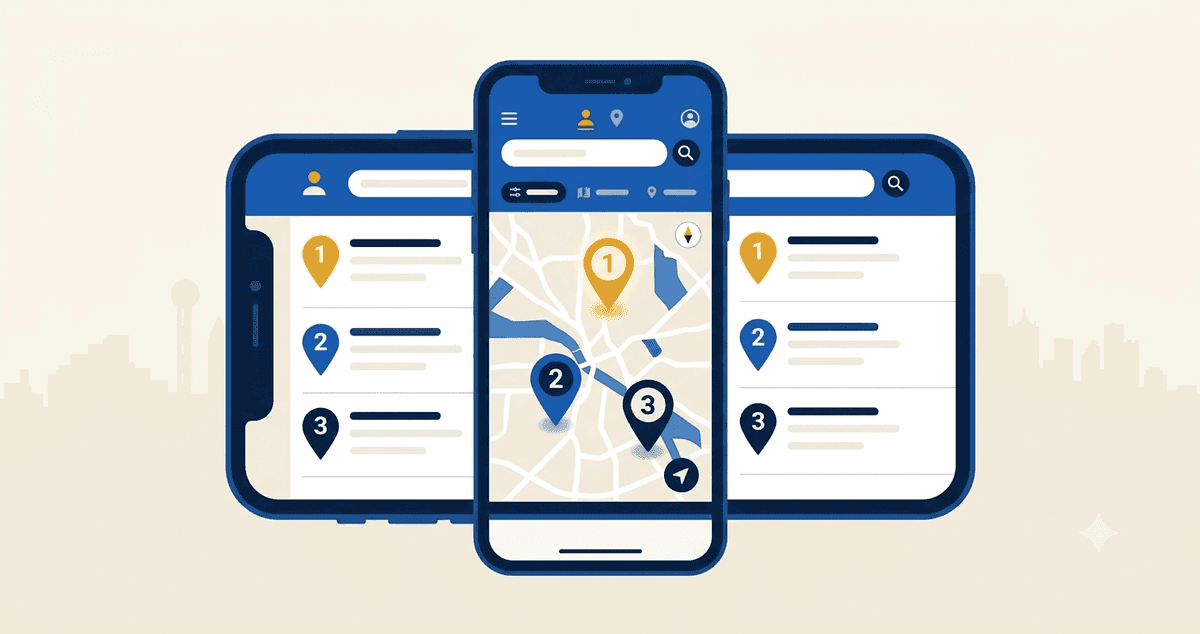
Someone in Arlington searches “electrician near me” and Google hands them three businesses at the top of the screen with a little map. Most people pick one of those three. They never scroll to the regular links below, and they definitely never make it to page two. Those three slots are called the map pack, and in DFW they are the difference between a phone that rings and a website nobody finds.
I have been doing local SEO for DFW service businesses since 2015, and getting into the map pack is the single highest-leverage thing most of them can do. The good news: it is not a mystery, and your competitors are mostly not trying. Here is the plain-English version of how the map pack works and how you get into it.
What the map pack is, and why it matters so much
The map pack, also called the local pack or the three-pack, is the block of three businesses Google shows with a map when someone searches for a local service. It sits above the normal search results, which means it grabs attention before anything else on the page.
The numbers are hard to argue with. Roughly 46 percent of all Google searches have local intent, meaning nearly half of everything typed into Google is looking for something nearby. And the businesses sitting in those top three map spots pull the large majority of the clicks for local searches. If you are not in the three-pack for what you do in your part of the metroplex, you are close to invisible to the people most ready to call.
This is also why local SEO is the best-value marketing most service businesses can do. You are not fighting the whole country for a ranking. You are competing with the other shops in your city, and most of them have neglected the exact things that win.
How Google decides who gets in: relevance, distance, prominence
Google uses three factors to pick the three businesses it shows. Once you see them, they make sense.
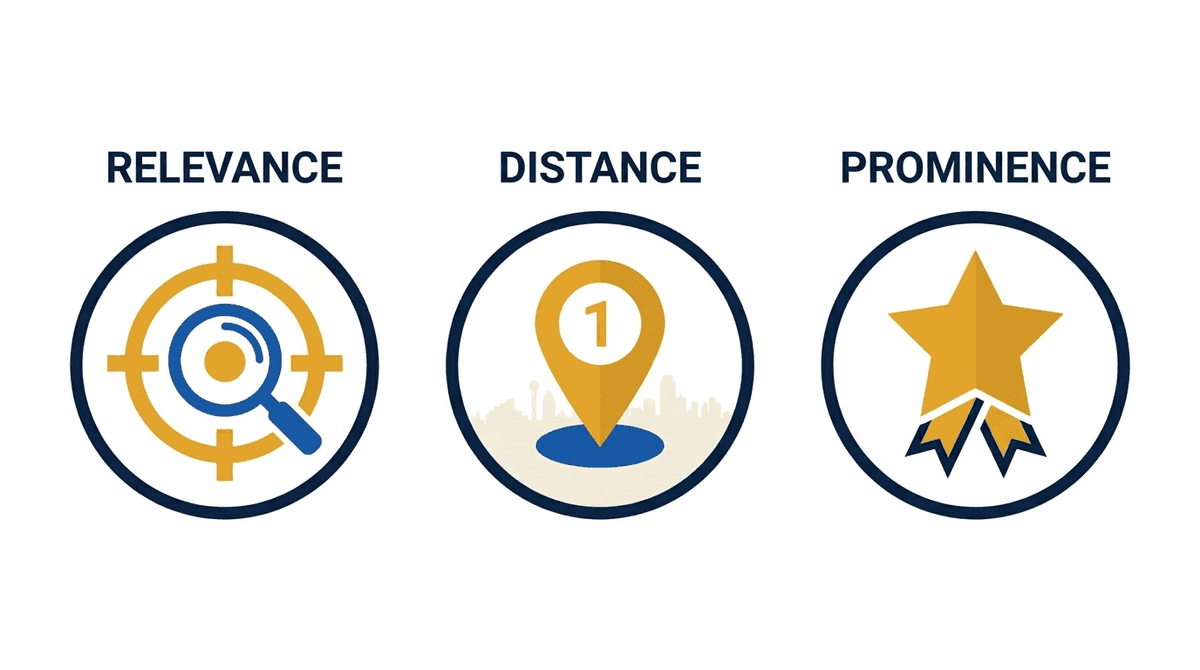
- Relevance. How well your business matches the search. This is driven mostly by your Google Business Profile category and the services you have clearly listed. Pick the most specific primary category that fits, “Electrician,” not “Contractor.” If you do panel upgrades but never said so, you will not show up for them.
- Distance. How close you are to the person searching. You cannot move your shop, but you can be accurate and honest about the areas you actually serve, which helps Google place you correctly for the right searches.
- Prominence. How known and trusted your business is. This is your reviews, how complete and active your profile is, and your reputation across the web. This is the lever most owners ignore, and it is the one with the most room to grow.
According to the Whitespark 2026 Local Search Ranking Factors report, the large majority of the top ranking signals for the map pack come straight from your Google Business Profile. No other single thing concentrates that much ranking power, which tells you exactly where to spend your effort first.
Your Google Business Profile is the engine
For the map pack, your Google Business Profile matters more than your website. It is what Google reads to build those three results. A complete, active profile with accurate categories, real photos, honest service areas, and a steady stream of recent reviews is what gets you in. A thin, ignored profile keeps you out no matter how polished your site looks.
If your profile has the wrong primary category, no recent posts, and a name, address, or phone number that does not match what is on your website, you have found your problem before you have spent a dollar. That mismatch alone, even something as small as “St.” versus “Street,” chips away at the trust Google places in your listing.
Reviews and NAP: the two things that quietly decide it
Two things do a lot of heavy lifting in the map pack, and both are within your control.
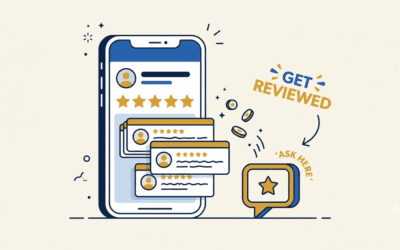
Reviews. It is not just the star rating or the total count. Google looks at how fast new reviews come in, whether they mention what you do, and whether you reply. A steady trickle of fresh reviews with owner responses beats a pile of old ones that nobody has touched in a year. Ask every happy customer, make it easy, and respond to all of them.
NAP consistency. Your Name, Address, and Phone need to be identical everywhere they appear online, your website, your profile, every directory. Google cross-references these to confirm you are a real, locatable business. Inconsistencies suppress your ranking, so this boring cleanup job is often the fastest win available.
Where your website still pulls its weight
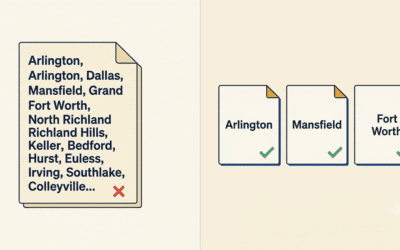
Your profile feeds the map pack, but your website backs it up, and it is where you can pull ahead of competitors who stopped at the profile. Location-specific pages with genuine local content outrank generic service pages for local searches every time. A roofer who serves several DFW cities does better with a real page for each area than one “service areas” paragraph that lists them all.
That is exactly why I build dedicated local pages for the cities I serve, like local SEO in Arlington, Fort Worth, Mansfield, and Dallas. Each one gives Google a clear, honest signal about who I help and where, which is the same thing your site should do for your service area.
Add LocalBusiness schema so Google can read your business details in a structured way, keep the site fast and mobile-friendly, and put a tap-to-call phone number on every page. The same profile and site work also feeds AI search, which is becoming its own version of a local search. I cover that in my post on how DFW service businesses get found in AI search, and the short version is that the work that wins the map pack is the same work that gets you named by AI.
Your map pack checklist for this month
If you want to climb into the three-pack in your part of DFW, here is the honest short list, in order:
- Claim your Google Business Profile and fill out every field, with the most specific primary category and all your real services listed.
- Fix your NAP so your name, address, and phone match exactly everywhere online.
- Set your true service areas, the actual DFW cities and neighborhoods you cover.
- Add real photos of your work, your team, and your trucks, and post to the profile regularly.
- Build a steady review habit, ask every happy customer, and reply to every review.
- Back it with local pages on your site for the cities you serve, plus LocalBusiness schema and a fast, mobile-friendly build.
None of this is complicated. It is just rarely done well and never finished, which is the whole opening. Local SEO is not a one-time fix, it is a habit that compounds. The business that shows up in the map pack a year from now is the one that kept at it while everyone else set it and forgot it.
Frequently asked questions
Can I pay Google to be in the map pack?
No. The three organic map pack results are earned through relevance, distance, and prominence, not paid for. You can run Local Services Ads or Google Ads that appear near the map, but those are separate paid placements. The organic three-pack cannot be bought, which is good news, because it means consistent work can get you there without an ad budget.
How long does it take to get into the map pack?
Once your Google Business Profile is fully built out and you are gathering reviews consistently, many DFW businesses see movement within a few weeks to a couple of months. Competitive categories and dense areas like central Dallas take longer than smaller suburbs. The steadier your reviews and activity, the more durable your spot becomes.
Why is my competitor in the map pack when my business is better?
Usually because their Google Business Profile is more complete and more active, with more recent reviews and a category and service list that matches what people search. Being a better business in person does not automatically show up in Google’s signals. The fix is to make your profile and reputation reflect the quality you already deliver.
Want help getting into the map pack?
If you run a service business in the DFW area and you are tired of watching competitors sit in the top three while you stay buried, that is exactly what I do at PC Designs. Take a look at my local SEO service, or reach out and let’s talk about getting your business found.